Couples kissing in front of the Tower Bridge view line Sacré-Cœur Basilica, at Montmartre The Eiffel Tower, while cruising on the Siene River Jungfraujoch, the Top of Europe Pietà

2013년 9월 15일 일요일

Crimson Red

            The sun sets low in the horizon. What’s left of it drenches the sky with big drops of orange and yellow on a canvas soaked in crimson red. The vigorous but dazzling colors blend harmoniously to create a breathtaking concoction. Even the vultures circling above seem to be awe-stricken by its beauty, as they seem unable to fix their gaze from the sun. Something so beautiful makes one feel all warm and snug inside, but yet even such beauty fails to maintain its original charm and turns into an eerie, violent sight when it’s reflected in the empty eyes of the dead. 500,000 dead bodies are lying on the battlefield, leaving just enough space to spot the blood soaking the soil and grass in oozing puddles. The entire field reeks of raw flesh, decaying bodies, and oozing blood. This unbearable stench would have knocked out any ordinary man, but I do not waver. The continuous assault on my nose had already made it go numb and I was too busy trying to suppress the overwhelming emotions that kicked at my lungs. Nevertheless, as I stepped over the corpses of my comrades, looked into their blank eyes, and saw the illusions of their families that would be waiting for them back home, I could not stop the tears from clogging my sight nor my lungs from screaming in agony.
             My love, this was the day our race was brutally massacred by the Homo erectus, the day we parted for eternity. Do you remember? Do you remember the sunlit days we spent together? Do you remember how you would dig deep into my chest and hold me dearly? Do you remember how my lips would passionately meet with yours, so delicate and soft? I doubt that you do. For such things never were. I remember that I had given you all I could, from foods and clothes to all the love I could find at the bottom of my heart. However, such things never seemed to satisfy you. You always willed for something I could not give you, a Homo erectus husband. You always complained about how powerless, impoverished, dull-witted, and grotesque we were compared to the Homo erectus. You even tried to escape our camps and run off to the Homo erectus, but every time you tried, I strived even harder to keep you by my side. For I had loved you, more than a mother does her only child, more than the moon does the sun, and more than the stars do the moon.
             My love, I had been a fool to have given you my unconditional love. I had been a fool to neglect the inevitable and evident future that lied ahead of us. I had been a fool to wish that my worst fears were mere creations of my imagination. I regret that I had only recognized my foolishness just minutes before I ceased to exist. Even when I was standing amongst the dead bodies of my comrades, all I could think of was you. For if it weren’t for my heart’s desire to see your face again, I would have imploded under the weight of all that had happened to me. I had watched my friends have their heads decapitated and their arms severed right in front of my eyes. I had heard them call in screams of agony for their loved ones, begging for mercy. I had felt their blood splatter onto my face and blind my eyes. I had tasted their bare flesh, so that I would at least die while trying revenge my comrades instead of starving to death. And yet, when all of it ended, I looked around to see that I was the only survivor, standing in a sea of corpses. I didn’t know what to tell the families back home, waiting for their fathers and husbands to return. I didn’t know what to do when the screams of my comrades still echoed in my ears and visions of their deaths flashed in front of my eyes. I wanted to free myself from the weight of the world on my shoulders. However, my heart forced me to do otherwise. At the thought of seeing your face again, I held myself together and swam through the sea of corpses for seven days and nights. And when I arrived, you were nowhere to be seen. The only people who awaited me back at the house were our sons and daughters, who had already turned into cold corpses for having starved for weeks.

             I had been defeated by natural selection. With nothing more to await, I fled out of our house and flung myself off the cliff, into the cold, hard surface of the ocean. Eons after my death, I still wander the face of Earth, trying to find the answer to my question, “Why is it that my heart still longs for you to be by my side?”

2013년 7월 7일 일요일

Korea’s Paradox


            Tracing back into the remnants of history, the survival of the human race has based itself fundamentally on communal living. Experience has taught us that when acting in groups, we show an increase in rate and range of activity. However, looking more into the nature of our species, we possess a psychological desire to interact with others of our species as we are social beings. Therefore, even the earliest memories and records of our race show signs of people living in communities rather than individuals. The start of these communities was indeed very small, limited to one to several families. However, continuous conquests and the development of technology increased the size of these communities and made way for new possibilities and necessities. A perfect example of such a necessity is the need of a chosen number of people to lead and maintain order within the society. These communities continuously grew until they congealed into the form of countries, kingdoms, nations, and empires. The size of these groups differed, but the core of each nation was similar in that the members are people who live in the same land.

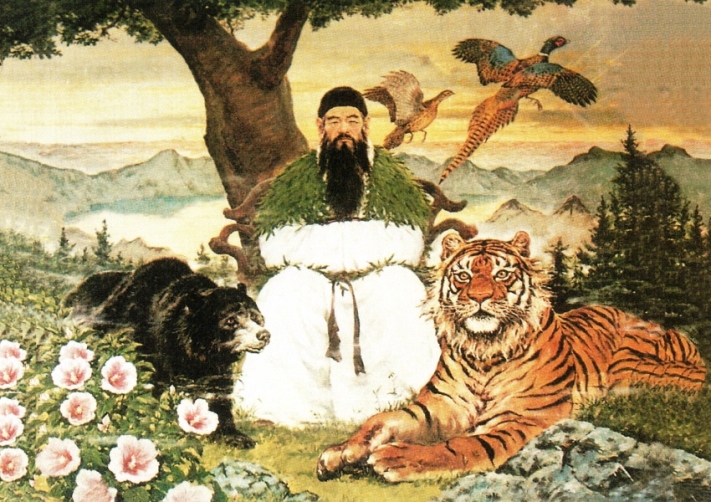
             When in times of despair, such as a war or a plague, unification provided power for these communities and led them to power in many occasions. Therefore, kings, queens, emperors, dictators, and governments have sought ways to bring the citizens “to one” so that they can “serve their purpose.” Even before romantic nationalism was brought about by the ideas of Rousseau and Johann Gottfried von Herder, there were many instances in human history where leaders tried to plant extreme patriotism into the minds of citizens. One of the most common methods of doing so has been to create stories and myths about the great accomplishments of our ancestors and link the citizen to the land as well as the blood that flow within ourselves. Examples of such stories are national epics and folk talks like those of the Brothers Grimm and the Dangun mythology.
File:God kväll, farbror! Hälsade pojken.jpg
 Drawing from Swedish Folklore
Dangun Mythology
              However, times have changed. The human civilization has taken another step from the limited unit of nations and countries. Although the world is still organized in these units and we are heavily influenced by the policies of individual governments, people are now capable of easily moving to another country and are given mobility rights. There are those who try to challenge this modern trend of globalization and claim that it will only increase the gap between the rich and the poor. However, what’s clear is that restricted regions cannot fulfill human needs to its fullest and so the range of human activity continues to widen. This phenomenon is what fuels the globalization boom and is something we cannot deny.


             Under such circumstances, past ideologies of romantic nationalism to more extreme forms of nationalism, such as Nazism, are being reconsidered. They are being thought of as unreasonable, impractical, and moreover discriminative especially toward foreigners. It’s viewed as a barrier in achieving globalization. To add on, organized efforts to maintain peace and international interest in curing diseases show that the need for unification by nationalism is no longer necessary as now we serve a bigger purpose, the preservation of peace and mankind. Therefore, nationalism now remains as a remnant of the past.

            However, the Republic of Korea has recently been walking along the footsteps of mankind backwards. The government’s policies seem to support globalization, but at the same time they try to revive the ideology of “minjok,”which roots in the archaic ideas of romantic nationalism. It’s because of these policies that the overall understanding of citizenship within the country is based on the sharing of a common bloodline and ancestry. Such a concept of nationhood based on race is the main factor in discouraging foreigners from seeking a life in Korea and in preventing Korea from becoming an international hub. Yet, the government still carries out such “minjok” policies alongside with its plans for globalization. In order to understand this paradox, it’s essential to look into the history of the ideology and take a new perspective into what it means to be a Korean.

History of “Minjok”
             Unlike the general consensus within Korea, the “minjok” ideology is rather young. It was created during the early 20th century, during the period of Japanese colonialism. In order to assimilate Korea into the Greater East Asia Co-Prosperity Sphere as an obedient colony, the Japanese tried to input the belief that Korean and Japanese citizens share the same origin, but also that the Japanese are superior. Such belief would have had simplified the following process of eliminating Korean cultural traditions and replacing them with Japanese ones. This step included the mandatory usage of Japanese names as well as the language, instruction of the Japanese ethical system at schools, and the worship of Shinto. Although the policies had certain levels of effect, the Koreans resisted strongly toward the compulsory elimination of their cultural identity and the outcome of their resistance was “minjok.” “Minjok” was first mentioned by Shin Chaeho, the founder of the nationalistic historiography of Korea and a Korean independence activist, in his “New Reading of History” of 1908. It defined the “minjok” as a warlike race that had fought courageously to preserve Korean identity, had later declined, and now needed to be revived. Due to the situation at the time, this concept that gave uniqueness to the Korean cultural identity gained great fame and spread spontaneously.

The “minjok” ideology grew even stronger and began taking place as an old Korean heritage when more support came from historians like Shin Chaeho and even the Japanese. As it became clear that the primary approach to the Koreans failed, the Japanese changed their policy to creating a patriotism restricted to the Korean ethnicity. They encouraged the Koreans to take pride in their ethnicity and this significantly empowered the “minjok” ideology. Another important trigger to the vast outspread of this metanarrative is Shin Chaeho. His publication of the “Joseon Sanggosa” during the years of 1924 and 1925 created a whole new perspective of the history of Korea. He first proclaimed that Koreans are the descendants of Dangun, who was introduced before in the Buddhist monk Iryeon’s “Samguk Yusa” in the 13th century but remained as a legendary figure. Shin Chaeho also identified the martial roots of the Koreans in Goguryeo, a military and expansionist country, which encouraged resistance against the Japanese. Other new understandings of Korean history are the replacing of Gija Joseon, which was believed to be founded by a Chinese royalty, with Dangun Joseon to strengthen the uniqueness of “minjok.”

             This Korean concept of minjok is similar to Facism of Italy, Nazism of Germany, and nationalism of Japan in that they all are extreme forms of romantic nationalism. Although many Koreans try to deny this fact and the world has yet acknowledged “minjok” as ultranationalism, there is a clear similarity in that the four all proclaim ethnic homogeneity and the preservation of pure blood. However, there are also definite differences. Unlike Italy, Germany, and Japan such ultranationalism did not lead to a full-on war against the world and therefore it has not received any forms of restrictions by the rest of the world. This lack of limitation is the reason why “minjok” continued to exist as a form of “cultural heritage” within Korea even after the end of the Japanese colonialism.

             However, there was also something else that added fuel to the fire and continued the “minjok” legacy. It was the Korean government. Especially when it comes to the dictators and military regimes that formerly took power in Korea, the government made use of the “minjok” ideology to unite the people and serve for the nation. A typical example of such government usage of nationalism is the military regime of President Park Chung-hee in the 1960s. In order to legitimize his authoritarian rule, he strengthened the ideology of pure blood. However, not only did it empower President Park’s regime, but it also created a sense of sacrifice among the citizens for the "Great Han" race, which consequently led to extreme rates of development.

Problems Associated with Minjok

             Returning back to current times, there exists a widespread criticism of nationalism in the globalized society and yet “minjok” still roots deeply into the Korean society. Then exactly why is it that nationalism like the “minjok” ideology receives criticism?

             To begin with, a fatal flaw within the ideology of “minjok” itself is that it is all a fraud. Even its creation is known differently from reality. As mentioned above, the general idea of “minjok” within Korea is that it is a cultural heritage handed down from our ancestors from the very beginning of human civilization. Instead, it was actually created in just the last century. The reason why even the creation of the ideology is misunderstood is that the creators of “minjok” carefully engineered it in such a way. The separate words min, which means people, and jok, which stands for family, had been used very often for a long time, ever since the classical era. Therefore, the combination of these two words, which the Koreans were very familiar with, obscured the truth behind the creation of “minjok” and added an aura of naturalness as well as a sense of cultural importance to the ideology. Moreover, at the core of the “minjok” ideology stands legends, myths, and partial interpretations of history that are hard to refer to as actual evidence.

             Another problem created by the “minjok” ideology is the wrong emphasis on Korean culture. Due to the obsession of ethnic homogeneity created by “minjok,” one can often observe misinterpretations of universal phenomena and values as being Korean when sharing a discussion with a Korea person. A common example would be a Korean talking about how Confucianism had affected Korean culture in the past and so that they “respect the elders.” Confucianism did have a big impact on Korean culture in ways such as forming their own unique way of greeting elders, but the virtue of respecting elders itself is a universal value that can be found in any country. Another example that not many know of is about the Aesope Fable, “The Honest Woodman.” It is a tale that teaches the moral that “honesty is the best policy.” In Korea, many hear of this story ever since childhood and remember it throughout their entire life. The difference between the original Aesop Fable and the Korean version is that in the Aesop Fable appears the god Hermes, but in the Korean version appears a san-shin-ryung, which is a spiritual figure that guards the mountains. Because this figure has existed in Korean culture ever since the introduction of Taoism to Korea, many Koreans mistake that this tale as being “made-in-Korea” and are never told of the origin when they learn about it as a child. Therefore, even adults live on thinking that the tale of “The Honest Woodman” is “pure Korean.” Much of the responsibility for such misinterpretation can be said to lie with the Korean government. However, when it should be educating clearly what Korean heritage is, it instead carries out policies relating to the strengthening of “minjok.”


             Above all else, the biggest problem with “minjok” currently is the discrimination against foreigners. As “minjok” is a form of nationalism that emphasizes a pure bloodline, it blocks out the possibility of a foreigner or even “mixed-bloods” like Korean Americans from being Korean. This phenomenon in the Korean society is somewhat like xenophobia in that the Koreans are afraid to embrace foreigners into their society as people with Korean nationality. In the case of mixed-race people and migrant workers in Korea, the majority of them face various forms of discrimination and prejudice. Famous mixed-blood stars such as football player Hines Ward and singer Yoon Mi-rae are doing their part in the society as they show effort to decrease the discrimination by creating charity foundations or guaranteeing education to the children. This pure blood theory eventually became an international issue in 2007 when the U.N. Committee on the International Convention Elimination of All Forms of Racial Discrimination began paying attention to it. However, what’s more interesting is the response of the Koreans. There were certain levels of positive intakes of the international issue, but what’s shocking is that certain Koreans raised concerns about foreigners invading the Korean culture and challenging their national sovereignty. In the era of globalization and democracy, there is in no way that Korea can keep up to the development in international relations and become a multi-cultural hub if it continues to maintain the “minjok” ideology. 


The Future of Korea and what it means to be Korean

“Minjok” is a form of nationalism that ties the people to the land and pursues the preservation of pure blood. Then, there is patriotism. Patriotism’s original definition is the cultural attachment to one’s homeland. More specifically, it is the love and loyalty one is willing to give to their homeland. However, modern definitions of patriotism show a more broadened perspective on love toward a nation. It now refers to the strong love one feels toward the country they are attached to, which may and may not be the country one was born in. It is such patriotism that should define a person’s nationality, not his or her blood or skin color. If a foreigner shows passion and great attachment to the country of Korea then he or she should be called a Korean just like any native Korean. In order for Korea to truly seek globalization and become a multi-cultural hub, it needs to open up to foreigners and mixed-blood people. The criteria of nationality should no longer be blood but the attachment one has to the country and the willingness he or she possesses to carry out duties for the privileges the country will give to the individual.


             What the country needs for a change in the overall atmosphere of the society is a trickle-down effect and the perfect starting point for it is a change in the policies of the government. It primitively needs to end further support for the idea of “minjok.” However, the Korean government also has a responsibility to change the course of its globalization policies as well. The current globalization policies focus on the spread of Korean culture and the creation of an international interest in the details of the country of Korea. This is the reason why in many of globalization promotion pictures put in public by the Korean government are of foreigners eating kimchi. Rather than trying to maintain a Korea-centered analysis of the world, Korea itself needs to open up to the diverse cultures of the universe without discriminating them. The new focus of globalization should be to accept diverse cultures and people with open arms as well as seeking to spread Korean culture.

2013년 6월 6일 목요일

Euro Debt: Should the euro zone's debt be mutualized?


Paul De Grauwe and Ansgar Belke both agree that debt mutualization would bring along certain dangers, such as morality issues and the burden put on creditor countries through the increase in costs. They also agree that it’s important for European countries to pull weak banks and sovereigns from a vicious cycle. However, they differ in terms of solving the problem itself. Mr. De Grawe believes the problems brought along with debt mutualization could be avoided through careful measures, such as imposing conditions on the beneficiaries of debt mutualization. In addition, he believes joint-issued debt would solve the problem of weak sovereigns with the richer countries guaranteeing the debt of the weaker ones to a certain extent. He defines the main threat to the Eurozone as being mere fear and panic that can lead to a sudden increase in borrowing costs. On the opposing side, Mr. Belke believes that the flaws of mutualization are unavoidable and so the European Union should not resort to such methods. Instead, the E.U. should start with saving banks through stronger central management and shared-liabilities among certain banking sectors. His definition of the main threat also differs from Mr. De Grauwe. He claims it is the untimely removal of market pressure and talks about how debt mutualization will only add on a political backlash, related to the disproportionate liabilities put on creditor states.

Arts Funding: Should governments fund the arts?


With the government incapable of sufficiently funding the basics such as education and health, there has been a major decrease in public, as well as private, funding for the arts. While those in the art industry have been expressing their grief in many extreme ways, the general opinion is that the government does not have a responsibility over funding of the arts. Most simply assume that it would be better to use tax on street lights and hospitals rather than art shows and galleries. However, Alan Davey, who is the current chief executive of the Arts Council in Britain, takes on the opinion of its founder, John Maynard Keynes. Keynes’ belief that public funding in arts would bring economic and cultural benefits is what brought the council about. Such movements to bring about public spending are what enabled Britain to be a hub of top quality museums and theatres with affordable prices. Public support also brought about more private funding as well. In the end, it all boils down to increase in cultural export, quality of neighborhoods, number of jobs and tourists, and an abstract sense of pride in each citizen. However, Peter Spence of the Adam Smith Institute argues that government interference in arts rather does more harm than good. With the government involved, the censorship brought along would put a limit to the creativity of artists. It gives the government the power to choose which type of artists to root for, leading to a situation where artists are merely trying to satisfy government donors and their political beliefs. There is much debate about this topic and the question still remains, could we leave the future of arts up to the market during a time of economic difficulty?

Offshoring & Outsourcing: Do multinational corporations have a duty to maintain a strong presence in their home countries?


An outsourcing trend had spread among the multinational corporations with not only basic manufacturing work, but also crucial functions such as R&D being moved to fast-growing markets. However, the Great Recession’s impact has caused many to hold grudges against such trends. Therefore politicians are pressuring firms to keep operations within the borders or bring them back home. With so much objection expressed toward corporations going overseas, they have started a kind of trend called “reshoring,” in fear of further public dispute. Now, even chief executives are emphasizing the importance of staying, rather than expanding. They proclaim that firms have a duty to their home country and that it’s also in the best interest of the corporations as well. Among such supporters is Harry Mosers, who is the president of GF AgieCharmilles and claims that the firms have a responsibility to pay back to the state that have granted them privileges right from the beginning. He also states that merely going offshore due to the bandwagon appeal and with no correct measuring rather damages the firms. On the other hand, professor of economics and law at Columbia University, Jagdish Bhagwati, says we should tilt our head toward reality, in which multinationals do make profit from foreign investment.

Affirmative Action: Is affirmative action a good idea?


Many different governments have carried out policies of affirmative action to compensate for past discrimination of racial minorities. Supporters declare that it shatters the glass ceiling, allowing certain ethnic group to enter higher economic and social status. Adding on, affirmative action creates a classroom of diverse ethnicities and makes up for the pure luck involved in birth by providing more opportunities to those who aren’t so lucky. On the other hand, opposing views point out how such policies only benefit the powerful and wealthy households of such ethnicities that have been historically discriminated. Further on, affirmative action cannot be justified as it’s merely an extension of discrimination by ethnicity and race. Professor Ashwini Deshpande further supports Affirmative Action by talking about how it will have a trickle-down effect with social minorities in decision making positions and how it will level the playing field. She also rebuts to a few points, such as the criticism that AA only further stigmatizes these minorities. She points out that AA counters the current stigma that exists independently and that critics should shift their focus to successful cases like the castes of India. She claims that the criticism about AA being regressive is merely a myth. On the opposing side, professor Lino A. Graglia states that AA is inconsistent with an important value that humanity upholds, equality. He claims the actual problem is that certain ethnic groups lack in certain abilities and that the society is merely trying to cover this fact up.

2013년 6월 3일 월요일

Monthly TOEFL Essay #2


The 21st century has begun. What changes do you think this new century will bring? Use examples and details in your answer.


             Change is what has brought development to the human race. It is also what has brought dispute and doom to our race as well. Change takes such a huge part of our society that one could say the course of history itself is a train of continuous changes. Even the simplest behavior or mistake that one individual makes could lead to a trail of events that could end up changing how the entire human race thinks. This is especially so in the 21st century with developed technology and fast exchange of information worldwide. We are now capable of so much more than a century before and hold even more possibilities and potential for further development. Therefore, people expect the twenty-first century to become a breaking point for mankind with all different kinds of accomplishments, such as exploring the space frontier. However, what people fail to notice is that there is also a negative side to change. Just as much how we’ve created potential for development, we’ve also made ourselves vulnerable by creating new threats that we’ve never seen before. Therefore, in the new century, we can expect new discoveries to be made, but also extreme changes that will critically damage our race.

             One that’s expected to have the biggest impact in the twenty-first century is climate change caused by global warming. The start of this problem roots all the way back to the industrial revolution. The industrial revolution has always been known as the number one tipping point in human history that has allowed us to strive. However, it’s because of the industrial revolution that we have become so heavily dependent on fossil fuels, emitting thousands of tons of greenhouse gasses into the atmosphere. Consequently, the Earth’s temperature has been steadily rising and the rate has increased during the last twelve years in the twenty-first century. Scientists say that we have to keep within the threshold of two degrees above pre-industrialization temperature. The general consensus is that two degrees is when the Earth’s is knocked of its natural cycle and so we have to act before it’s too late. In addition, the threat seems to be imminent as scientists claim that we have to reduce our emissions by a significant amount until 2015 or we won’t be given another chance. The most dangerous aspect of global warming is that it’s a change that occurs on a long period of time. As the human species have evolved to deal with direct threats, such as a raid, dangers that occur on a wide time horizon are not easily perceived. In addition, in order for one to live an eco-friendly life, he or she has to give up the industrialized way of life and the profits it may bring. With a lack of a clear harm or an absolute profit, people tend to push the idea of global warming to the corners of our brain. When climate change hits our society in such conditions, the results would be catastrophic.

             Another disastrous change in the 21st century is the lack of resources. There are several aspects that have contributed to the development of this problem. One is the increase in population due to the development of medical technology and increase in quality of life. Another is consumerism. Now, people no longer think carefully before buying a certain object or throwing it away. Instead of weighing the costs and benefits, they consume depending on their logos or popularity and throw away even if it’s still good for use. Not only that, but also the pollution brought along by industrialization has poisoned the air we breathe in and the water we drink, causing certain resources to be unfit for use. Such phenomenon wouldn’t have been a problem during the pre-industrialization times. Even during the very beginning of industrialization, these problems were hard to notice. However, as the rate at which these problems grow increases and the intensity becomes hard to fully grasp, it’s now time for Mother Nature to retaliate. During the first decade of the twenty-first century, we have seen scientists and the media showing a sudden concern in the decrease in resources. We have also seen Mother Nature suffer from incurable symptoms, incapable to support as anymore and oil prices skyrocket to the roof. This is just the beginning. Many predict that within the twenty-first century, the accumulated rate in which we consume and contaminate would end in a catastrophe.


             Of course, there is still much controversy over the effects of global warming and climate change. Some believe it’s merely another step in the cycle of nature. However, the crucial fact that nobody can ignore is that the human race is clearly taking up a big part in this process and that the Earth is not reacting so well until now. Glaciers are melting, sea levels are rising, the four seasons seem to forget at which time to arrive, and parts of the Earth are literally dying. In the end, it’s inevitable that these two critical changes will happen within the twenty-first century, looking at the rate at which the problems are developing. However, it’s also crucial to believe in the power of man. The power to pull out all there is inside of oneself and display god-like abilities when put in a rather abysmal situation has saved our race from many apocalypses. The same could apply in this case as well. In addition, we cannot ignore what we’ve achieved until now and the positive changes awaiting us in the twenty-first century. Another ninety years awaits us, and there is much we will accomplish.

2013년 5월 7일 화요일

Horace Miner's "Body Ritual Among the Nacerima" reflection

           Anthropologists say that in the first three seconds of meeting somebody, people already create an impression of themselves to the person they are talking to. It seems that the same applies to writings as well. My first impression of Horace Miner’s “Body Ritual among the Nacirema,” was that it’s one sophisticated anthropology report that uses an awful lot of fancy words. Suppressing my urge to ignore such a writing that would give me a headache, I continued reading on and began to get a grasp of the material it dealt with. It seemed like Horace Miner was trying to emphasize how meaningless and gruesome the body rituals of the Nacirema, a tribe indigenous to North America, are. His interpretations of their rituals seemed to lack proper explanation and key elements in some parts and they seemed too extreme, but the first impression created by his style of writing persuaded that an indigenous group called the Nacerima does exist.
             However, few days later, we were told the truth behind Miner’s report. It turns out the essay is actually about the lifestyle of modern Americans and that “Nacerima” is “American” spelled in reverse. After a moment of awe and realization, I noticed how just a little difference in style of writing could make absolute nonsense seem like a documented anthropology article. It occurred to me that once something of the simplest matter is wrapped in words of professionalism, people would take it for granted as being carefully analyzed by experts of professional knowledge. Once that premise is set, people, including me, would believe even the most ludicrous rubbish ever told to them.
             The second point that occurred to me was the problem of perception. Beyond the fact that the essay deals with cultural relativism that befalls due to differences in morals and views, it seemed that these misrepresentations are also products of ignorance. “If people of different civilizations do have varying perceptions on the same issue, why can’t we try to understand such differences?” The problem with individuals of different civilizations is that they recognize this difference in spectacles, but they don’t give the effort and try changing their spectacles for once. They maintain a third person’s position and ignorantly do not engage. In my understanding, the narrator in Horace Miner’s essay seemed to observe the Nacerimas in a similar way. By extremely referring to everyday, simple activities of the Americans as spiritual and magical rituals, it didn’t seem like a simple matter of distinctness, but rather being effortless and unwilling to find the essence behind the activities. Such can be applied to other sciences as well. Taking biology as an example, we observe species in the perspective of a human being and focus on what harm or benefit they might do to our species. If they do harm, we try our best to exterminate them. If we can benefit, we unintentionally end up driving them to extinction. Although there exists a crucial difference in essence, we lack the effort to change perspectives.
Keeping these two points in mind, I tried writing my own biological report. The following is a document about the evolution of the Ipas Omohens species, habituating on the planet classified as PE-4.55B


             Over the course of time, biologists have continuously observed the Ipas Omohens species and their remarkable capacity to adapt and evolve. However, regardless of the wonders that the Ipas Omohens represent, many have considered them to bear potential damage to our civilization. Claiming that catastrophe is imminent, we have decided to expose the roots and development of this species to come to a conclusion with the decision of their destiny.
Ipas Omohens are the primates of the family Hominidae and are the only extant species of the genus Omoh. They inhabit the planet classified as PE-4.55B in the SS galaxy. It is estimated that about 7.084 billion of these species are currently in existence and their origin differs from a certain mystical creature that lives in the atmosphere to similar primates. In proportion to their body size, they have a large brain, which is characterized by a well-developed neocortex, prefrontal cortex, and temporal lobes.
At the beginning of their evolution, the Ipas Omohens formed the bottom of the hierarchy of food chains on the planet PE-4.55B. However, their oversized nervous system has facilitated their adaptation to different environments and the use of different tools found in nature. Consequently, the Ipas Omohens settled among the lines of prey and predator. However, the harsh conditions on planet PE-4.55B had driven the Ipas Omohens to further evolution. Throughout a long period of time, they developed new organs that are easily amputated from and reintegrated to the body as it has its own life source. This life source is sustained by organic compounds that are obtained through the fractional distillation of petroleum. What’s magnificent about these organs is that they have enabled the Ipas Omohens to possess significant features of most of the strongest predators that live on the planet PE-4.55B. Throughout centuries of evolution, they have finally reached the top of the food chain.
Due to nature’s natural course of preservation, the Ipas Omohens protect themselves in cubic shelters, which are made out of a hard substance named opus caementicium and are gathered together in large groups. The main purpose of these shelters, apart from serving as a habitat, is to protect their organs and the tools necessary for survival. With dominance over all of the species on the planet PE-4.55B and enough protective measures, the herds of Ipas Omohens had begun to grow and increase in number. Their dominance has led to the extinction and near extinction of many other species on the planet PE-4.55B.
In recent times, with a lack of a proper predator to fight off and a lack of resources to use as tools, the Ipas Omohens have started to wage territorial wars against each other. Each herd of Ipas Omohens has a separate group of male Ipas Omohens that serves this purpose. The territorial wars that these groups of males often fight are composed of throwing explosive fruits with metal casings that are shaped like the genitals of the male Ipas Omohens. Not only does this physically damage each other, but it’s an unnecessary display of the arrogant pride that many male Ipas Omohens possess.
Thus, scientists have come to the conclusion that the Ipas Omohens are violent species that are capable of destroying their home planet, themselves, and any object that they do not see fit. It is a mere matter of time until they seek the destruction of our civilization and therefore they shall be sentenced to extinction.

2013년 4월 16일 화요일

The Age of Stupid (Reflection)


                  I usually never see a movie more than once, unless if it’s something like the Lord of the Rings trilogy or the Matrix trilogy. If it’s a documentary, I usually dose off in the middle of it. However, in the case of “The Age of Stupid,” I bore through it three consecutive times and I actually found myself enjoying the documentary when I should be worried about the midterms I have in five days to come. I still find it way more entertaining than any Marvel movie like “The Green Lantern.” Then, what exactly makes this movie different from any other normal documentary that deals with the intensity of global warming?


                  Instead of merely taking a pathos appeal by documenting polar bears or exaggerating how the world will come to an end, “The Age of Stupid” takes a less abstract perspective and concentrates on the reality, the status quo. It does present the worst possible scenario of what the world would be like in 2055, but it focuses more on the harms climate change has done to the human race, making this issue more concrete for viewers to perceive. Above all, what makes this movie even more unique is that it tries to answer a fundamental question. “Why couldn’t we have saved ourselves?”


                  Additionally, beyond the material that this movie deals with, what’s even more appealing is its method of presenting it. The first time I saw this movie, I didn’t actually realize what this movie was exactly about. I just thought it was a simple documentary on climate change showing several cases to prove its point. However, what caught my attention was the man named Jay Wadia. Why would somebody talk about an entrepreneur when trying to prove that global warming is an imminent harm? Then it struck me that this movie had implied messages within each of the cases it presents and that there is a reason why it’s called “The Age of Stupid.” The movie presents hidden links between each of the recording that show that it’s not that we didn’t but we couldn’t save ourselves to begin with. We were stuck in our own trap. With our entire economy based on fossil fuels and the human race fixated on fulfilling its own greed, we had no choice but to come to our downfall. It appealed to me as amusing that one could weave such an intricate web of links to prove such a common idea. This made the concept seem more realistic and fresh and it was actually fun to find the links between the recordings and the contradiction hidden inside them.


                  Jay Wadia is a 32 year old Indian entrepreneur who started a low cost airline in 2005. His goal is to provide a cheap and fast way of transportation for the 15 million people in India who use the train, which he finds is just too expensive compared to its quality and speed. The fact that he doesn’t know is that flying is the worst thing an individual can do to cause climate change, other than setting fire to a forest. (Information provided by the Pierres, a family devoted to stabilizing climate change) He’s marveling at how the U.S. has three times more airplanes on the southeast trail than India has as a country, when it’s one of the most significant causes of global warming. The bigger goal he has is to promote consumerism and eradicate poverty. He believes it’s nonsense that only the “elite class” gets to get on a plane. He believes cheap and fast transportation will bring about faster business, which leads to more disposable incomes, and more disposable incomes will bring about consumerism. First of all, his goal to “eradicate poverty” seems quite hypocritical especially because he’s criticizing the “elite class” when he’s own of the richest few in India. However what’s more is that he’s once again trying to promote one of the evils of the world, consumerism. Ruthless consuming and buying of products has caused human beings to think less about the precious resources their wasting but rather focus on their own greed. The sister and brother living in refugee camps in Jordan show how the Naciremas, the perfect example of consumerism, throw away shoes that can still be worn if mended without second thought. It’s a waste of resources and Jay praises the American lifestyle. As you can see, he’s merely a businessman trying to find his way into a new industry to earn a living.

                  Alvin Dubernae is a survivor of the hurricane Katrina, a perfect example of the natural disasters created by climate change. He was well prepared for the hurricane and had a boat to use afterwards, but he figured out a lot of his neighbors stayed behind and weren’t so well prepared. To add on, all the coast guards were all in another part of the world, fighting a war in Iraq over oil. Therefore, Mr.Dubernae felt the obligation to save his neighbors. Yet, he works at Shell, even though he knows the consequence of oil drilling. In Nigeria, a woman who wants to become a doctor talks about how villagers of a neighboring village were massacred due to a dispute over land ownership with Shell. In addition, the nearby oil drills have killed most of the fish, making it harder for her to gain money for medical school, so that she can become and actual doctor and help does suffering from contaminated water and skin diseases cause by the burning of gas in nearby oil drills. She knows how selfish these corporations are, using their political and economic power to do as they want, and yet she ends up selling diesel through the black market to gain money for medical school.


                  Like this, we can’t save ourselves because the oil industry forms the center of our society. People have provided solutions like the global cap. However, the idea of rationing and equality doesn’t seem realistic at all, when human beings are driven by greed, as seen in our history and especially the war for resources in this case. The only hope we have is individuals. Individuals like the Pierres and the French mountain guide who at least try to solve this problem. Of course, they are often rejected because “wind farms spoil the view,” but I believe individual effort will eventually call about a need for change among the governments as well.

2013년 3월 26일 화요일

Personal Narrative Speech


Black Accent?
             Last week, I was surfing on the internet when I saw a very interesting video on Youtube. In the video, a black man talk about a conversation he had with a coworker about his accent. The coworker had asked him, “Ronald, you don’t have a black accent.” The man says, “What? What do you mean?” So the coworker replies, “You know. You don’t have a black accent. You don’t talk like black people. Your people.” Many people assume a black person would talk in slang and slur their words even before they meet the person. Then, they find it weird to find the person speak in a British accent or a southern accent. The creator of the video emphasizes how people’s accents differ depending on the region they’ve lived in. Therefore there is no such thing as a “black accent.” Have you ever seen Obama speak like Tupac or 50cent?                                                                                                                                                                                                                                                                                                 
             I also had a similar experience related to my accent. In middle school, it was mandatory to speak in English in certain classes. Therefore, about a third of all the talking I did in a day was in English. With my friends exposed to my accent for such a long period, they started to notice something about it. One day, they finally decided to drop the question on me. I remember talking to my friend about an inappropriate song, when he asked me, “Why do you talk like that?” For a second there, a part of my subconscious urged me to stick my middle finger in his face. However, I suppressed my urge to do so and kindly asked, “Why do you say so?” He replies, “Your accent. It’s like somebody mixed a western accent with a black accent and put it in your mouth.” “Is there anything wrong with that?” I replied. “Yeah, dude.  An Asian talking like a black person? Man, it’s unnatural. Not cool at all, dude.”
             Until that day, I’ve never thought I had a black accent. I do occasionally say things like, “We ain’t got no workshop,” but apart from that I saw no similarities. However, even if I do so, is it wrong for an Asian to have a black accent? Or, is it wrong for a black person to not have a black accent? Is there such a thing as a black accent? In the modern world, many people go about on how globalization has become universal and how countries no longer have borders. However, in such a world where people of many different ethnicities and characters interact, would it be beneficial to hold such stereotypes? These stereotypes aren’t just about the accents people have. Whether they know it or not, people subconsciously assume what a person would be like even before meeting the person and in many occasions it limits the depth of their interaction. For example, many people hold the stereotypes that Asians are not good that team sports such as basketball. This is exactly why Jeremy Lin wasn’t able to go to a university that’s famous for its basketball programs. Of course he did end up playing basketball at Harvard, but he talks about how hopeless everything seemed when college coaches would just assume that he’d be bad just because he’s Asian. As for the black man in the Youtube video, he would probably turn his coworker’s life into a living hell as he’s the supervisor at his job and he was offended. Stereotypes, they may not be discriminatory, but they imprison your insight and perspective.

2013년 3월 21일 목요일

Dear Mr Menard,
I just wanted to thank you for your helpful comments!

2013년 3월 19일 화요일

How to improve?

I am very inefficient when using words to express myself. With a limited vocabulary and a lack of a useful brain I find it hard to create a satisfying sentence. Therefore, I end up using words that I don't necessarily need and repeat myself throughout a paragraph. When it comes to writing, my goal is to achieve the ability to write concise sentences. Short, but to the point with no colorful decorations of any sort.

2013년 3월 13일 수요일

Narrative Essay: Battle Royal


Battle Royal
             The few weeks after the move back to Korea from the States were blurry and dreamlike. I spent hours in my grandmother’s living room amusing myself with lego pieces. None of it felt real. Rather it was as if I was on vacation in Korea to see my grandparents. Even when our family moved into our new home and I started a new semester at the local elementary school, it felt as if I would wake up from this dream at my snug home in Seattle if I punched myself hard enough. But then, reality struck me when my mother dragged me to my first “hagwon.” Before I had any actual experiences at hagwons, I expected them to be educational institutes, as they are supposed to be. However, what I sensed when I entered my first hagwon classroom was quite different. Of course, the course itself was very educational, but what were strange were the looks the students had. They seemed like robots with the teachers inputting commands into their system.
             At first, all of this was absurd. All the aggressive competition seemed meaningless. However, soon I figured out we, students, had no choice but to become battle robots. Whenever I brought home a trophy or an award, my mother would try to act as if it was nothing, but I noticed the tips of her mouth bend slightly upwards. It wouldn’t have been such a big problem if all ended here. However, it seemed like my classmates and their parents made more of a big fuss then my parents. They would be astonished at the news of my accomplishment and would congratulate me with colorful words. But then, some would even go behind my back and chat about how it was mere luck. The list doesn’t end here. Hagwon teachers, neighbors, and literally almost everyone I know would overreact at such a notice. The funny thing was that the same applied for when I had bad results. A blend of sneers, ridicules, and judgmental views would surround me wherever I go. From these experiences, I learned that our society only acknowledges the best. In order to survive in such a society, I had no choice but to strive to become the best.
             Years later, I was accepted at a school named Daewon International Middle School, where everyone seemed so talented. With a hundred and fifty gifted people in one spot, all that I’ve accomplished so far began to look miniscule and dull in my eyes. I questioned the life I’ve lived up to that point, leading me back to the moment when I decided I have no choice but to become a studying machine. Since then, all that I was concerned about was being the best. And, what’s more astonishing is that I enjoyed it. I enjoyed standing on higher grounds than everyone else. Especially when I removed an opponent from the competition, I felt relieved and excited, like a psychopath when he kills his victim and successfully gets away with it. I had entered a series of battle royals. At first, I merely fought for the sake of survival. However, gradually the blood and killing appealed to me as exhilarating. 
                                
From the movie "Battle Royale."


2013년 2월 28일 목요일

Monthly TOEFL Essay #1:Know your ancestors and know yourself


Describe a custom from your country that you would like people from other countries to adopt. Explain your choice, using specific reasons and examples.

Know your ancestors and know yourself
           On Thanksgiving in the States, family members gather together to celebrate the holidays. It’s a boisterous and jolly period of the year when friends and families share new pleasant memories and reminisce about the past. In Korea, we have a holiday named Chuseok, which is exactly like Thanksgiving. It’s a chance to get closer with relatives and add some additional layers of fat to prepare for the upcoming winter. However, something exclusive about Chuseok is that relatives go visit the burial places of their ancestors to perform a commemorative ritual. This ritual started out as a method of thanking our ancestors for another successful harvest, during the times when agriculture formed the center of civilization. Although it lost this function after industrialization started off in Korea, this custom still remained as a part of Korean culture and was taken on by each following generation. Now, there is a moderate amount of families that have ceased carrying on this custom, but it still has a unique meaning to those who still appreciate this tradition. It’s a great way to spend one’s holidays in a more meaningful manner and it helps one develop his or her self-identity. These two factors are the main reasons that make this custom valuable enough to be shared by other countries.
             To begin with, visiting one’s ancestor’s grave makes up for how many people lock themselves in their rooms and spend the holidays aimlessly. It’s hard to deny that holidays are awaited by businessmen and student alike mostly due to the fact that they provide an opportunity to refresh one’s body and soul. However, when it comes to Chuseok, it’s not just a normal break from the frenzy at work or school. It’s one of the few times one gets to meet his or her grandparents, uncles, aunts, and nephews. In modern society, not many people understand the true value of this opportunity and they merely lock themselves in a room to get intimate with their phone or laptop. The perfect method to prevent this from happening is to take on the custom of visiting the tomb of one’s predecessors. Some might wonder why this is necessary when there are movie theatres and amusement parks that are available. The problem with these recreational activities is that they lack practicality as they aren’t compulsory and they attract people’s attention to a screen or some other medium, distracting them from having actual conversations. On the other hand, this custom has a mandatory tone to it as it’s an “important ritual.” Adding on, a trip back and forth from the tomb gives relatives plenty of time to talk about current issues or what’s new that’s going on in their lives. Although this may be completely different from this ritual’s original function, it’s meaningful that this custom serves the purpose of bringing relatives together, just like how Chuseok is supposed to be.
             Most importantly, getting to know one’s ancestors and their hometown helps to develop a better idea of his or her self-identity. In society, many people tend to question their existence on Earth and the importance of their life. They don’t understand why they have to suffer at work or at school to achieve something when there are many others who can do exactly the same thing. The first step in solving this problem is to acknowledge the fact that every single person has his or her own traits that non other has and build up one’s self-identity. This process usually starts with very fundumental questions, such as “Where am I from?” The ritual I mentioned above is how one could gain answers to these questions. Getting to know the home town from which his ancestors are from and excavating little pieces of information about the deeds of the ancestors could give one an idea of the family he’s included in. Such questions that seem very simple are what help students explain their uniqueness and develop a sense of self-identity.
             Of course, there are some religions that prohibit having any rituals for anybody who’s not their holy god. However, putting such differences aside, the role that this ritual plays for those who practice this ritual can’t be found anywhere else. Not only does it bring the family members close together on the holidays, but it also takes part in developing an individual’s self- identity. There may be difficulties, such as religious differences, in sharing this custom, but it does bring about personal gains to those who participate.

2013년 2월 22일 금요일

Who am I?


Who am I? Let's start off with the basics. My name is Minwoo Chang. If you find "Minwoo" an irritating name to pronounce or just don't like it, you could also call me Brandon. I was born on June the 26th, 1997. When I was seven I moved to Seattle, Washington and lived there for the next two and a half years. These years still remain in my memory as some of best I've ever had. The years of pleasure ended when I returned back to Korea and was introduced to what we, Koreans, call "hagwon"s. After three years of a back and forth

routine between elementary school and hagwons, I started a new chapter in my life at Daewon Middle School. Moving another three years into the future, we arrive at the present and I'm currently attending classes at Korea Minjok Leadership Academy.

Now for those who'd like to know me a little better, I'll introduce the people and activities that I'm most passionate about. I've been playing basketball for six years and I love playing the sport. Most basketball lovers play the sport because of the thrill they feel when the ball successfully touches the rim of the hoop and fall into the net. However, I mostly play it because of the energetic atmosphere within the court, the fast development of the game, and how the sport requires an intricate bond and understanding between teammates. As I love playing basketball, I enjoy watching NBA. My favorite team is the L.A. Clippers, and my favorite player is Blake Griffin.

         
 Another great interest in my life has been music. I believe music is a method people use to express their inner feelings during a certain experience or just a simple thought. It's a way of expressing oneself. So it doesn't necessarily have to contain a life lesson in the end, but it arouses one's feelings through lyrics and rythm. Of all the different kinds of music, I enjoy listening to many variations, such as rock, ballad, indie, hip-hop, rap, and etc. but I especially like rock and Korean Hip-Hop. I don't exactly have a favorite band as I like searching for many different bands and their different styles of music. Examples would be Muse, Sum 41, Oasis, Keane, U2, Greenday, Linkin Park, Franz Ferdinand, Hoobastank, Snow Patrol, The Killers, Neon Trees, My Chemical Romance, AC/DC, Aerosmith, Deep Purple, Santana, Nirvana. The following video is a music video of a song named "Back in Black" by AC/DC and "Hysteria" by Muse.

Apart from music and basketball, another hobby I share with some of my friends is debate. I don't exactly enjoy the tense atmosphere between the opposing two teams and the burden of having to prove that your perspective of the matter at hand is "better." However, I enjoy creating a logical flow, using different methods of reasoning and cooperation with your teammates. Therefore, I've been debating for some time now, and I plan on continuing.

I believe I have partly answered the simple question "Who am I?" for those who have read up to this point. I thank you for bearing with me and wish you have now obtained a better idea of who I am.