


Tracing back into the remnants of
history, the survival of the human race has based itself fundamentally on
communal living. Experience has taught us that when acting in groups, we show
an increase in rate and range of activity. However, looking more into the
nature of our species, we possess a psychological desire to interact with
others of our species as we are social beings. Therefore, even the earliest
memories and records of our race show signs of people living in communities rather
than individuals. The start of these communities was indeed very small, limited
to one to several families. However, continuous conquests and the development
of technology increased the size of these communities and made way for new
possibilities and necessities. A perfect example of such a necessity is the
need of a chosen number of people to lead and maintain order within the
society. These communities continuously grew until they congealed into the form
of countries, kingdoms, nations, and empires. The size of these groups differed,
but the core of each nation was similar in that the members are people who live
in the same land.

When
in times of despair, such as a war or a plague, unification provided power for
these communities and led them to power in many occasions. Therefore, kings,
queens, emperors, dictators, and governments have sought ways to bring the
citizens “to one” so that they can “serve their purpose.” Even before romantic
nationalism was brought about by the ideas of Rousseau and Johann Gottfried von
Herder, there were many instances in human history where leaders tried to plant
extreme patriotism into the minds of citizens. One of the most common methods
of doing so has been to create stories and myths about the great
accomplishments of our ancestors and link the citizen to the land as well as
the blood that flow within ourselves. Examples of such stories are national
epics and folk talks like those of the Brothers Grimm and the Dangun mythology.
 |
| Drawing from Swedish Folklore |
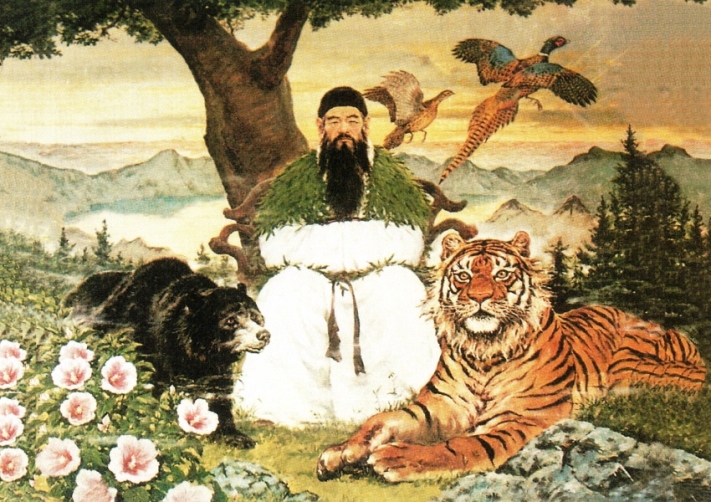 |
| Dangun Mythology |
Under
such circumstances, past ideologies of romantic nationalism to more extreme
forms of nationalism, such as Nazism, are being reconsidered. They are being
thought of as unreasonable, impractical, and moreover discriminative especially
toward foreigners. It’s viewed as a barrier in achieving globalization. To add
on, organized efforts to maintain peace and international interest in curing
diseases show that the need for unification by nationalism is no longer
necessary as now we serve a bigger purpose, the preservation of peace and
mankind. Therefore, nationalism now remains as a remnant of the past.
However, the Republic of Korea has recently
been walking along the footsteps of mankind backwards. The government’s
policies seem to support globalization, but at the same time they try to revive
the ideology of “minjok,”which roots in the archaic ideas of romantic
nationalism. It’s because of these policies that the overall understanding of
citizenship within the country is based on the sharing of a common bloodline
and ancestry. Such a concept of nationhood based on race is the main factor in
discouraging foreigners from seeking a life in Korea and in preventing Korea
from becoming an international hub. Yet, the government still carries out such “minjok”
policies alongside with its plans for globalization. In order to understand
this paradox, it’s essential to look into the history of the ideology and take
a new perspective into what it means to be a Korean.
History
of “Minjok”
Unlike
the general consensus within Korea, the “minjok” ideology is rather young. It
was created during the early 20th century, during the period of
Japanese colonialism. In order to assimilate Korea into the Greater East Asia
Co-Prosperity Sphere as an obedient colony, the Japanese tried to input the
belief that Korean and Japanese citizens share the same origin, but also that
the Japanese are superior. Such belief would have had simplified the following
process of eliminating Korean cultural traditions and replacing them with
Japanese ones. This step included the mandatory usage of Japanese names as well
as the language, instruction of the Japanese ethical system at schools, and the
worship of Shinto. Although the policies had certain levels of effect, the
Koreans resisted strongly toward the compulsory elimination of their cultural
identity and the outcome of their resistance was “minjok.” “Minjok” was first
mentioned by Shin Chaeho, the founder of the nationalistic historiography of Korea
and a Korean independence activist, in his “New Reading of History” of 1908. It
defined the “minjok” as a warlike race that had fought courageously to preserve
Korean identity, had later declined, and now needed to be revived. Due to the
situation at the time, this concept that gave uniqueness to the Korean cultural
identity gained great fame and spread spontaneously.
The
“minjok” ideology grew even stronger and began taking place as an old Korean
heritage when more support came from historians like Shin Chaeho and even the
Japanese. As it became clear that the primary approach to the Koreans failed,
the Japanese changed their policy to creating a patriotism restricted to the
Korean ethnicity. They encouraged the Koreans to take pride in their ethnicity
and this significantly empowered the “minjok” ideology. Another important
trigger to the vast outspread of this metanarrative is Shin Chaeho. His
publication of the “Joseon Sanggosa” during the years of 1924 and 1925 created
a whole new perspective of the history of Korea. He first proclaimed that
Koreans are the descendants of Dangun, who was introduced before in the
Buddhist monk Iryeon’s “Samguk Yusa” in the 13th century but
remained as a legendary figure. Shin Chaeho also identified the martial roots
of the Koreans in Goguryeo, a military and expansionist country, which
encouraged resistance against the Japanese. Other new understandings of Korean
history are the replacing of Gija Joseon, which was believed to be founded by a
Chinese royalty, with Dangun Joseon to strengthen the uniqueness of “minjok.”
This
Korean concept of minjok is similar to Facism of Italy, Nazism of Germany, and
nationalism of Japan in that they all are extreme forms of romantic
nationalism. Although many Koreans try to deny this fact and the world has yet
acknowledged “minjok” as ultranationalism, there is a clear similarity in that
the four all proclaim ethnic homogeneity and the preservation of pure blood. However,
there are also definite differences. Unlike Italy, Germany, and Japan such
ultranationalism did not lead to a full-on war against the world and therefore
it has not received any forms of restrictions by the rest of the world. This
lack of limitation is the reason why “minjok” continued to exist as a form of “cultural
heritage” within Korea even after the end of the Japanese colonialism.
However,
there was also something else that added fuel to the fire and continued the “minjok”
legacy. It was the Korean government. Especially when it comes to the dictators
and military regimes that formerly took power in Korea, the government made use
of the “minjok” ideology to unite the people and serve for the nation. A
typical example of such government usage of nationalism is the military regime
of President Park Chung-hee in the 1960s. In order to legitimize his
authoritarian rule, he strengthened the ideology of pure blood. However, not
only did it empower President Park’s regime, but it also created a sense of
sacrifice among the citizens for the "Great Han" race, which
consequently led to extreme rates of development.
Problems Associated with Minjok
Returning back to current times,
there exists a widespread criticism of nationalism in the globalized society and
yet “minjok” still roots deeply into the Korean society. Then exactly why is it
that nationalism like the “minjok” ideology receives criticism?
To begin with, a fatal flaw within
the ideology of “minjok” itself is that it is all a fraud. Even its creation is
known differently from reality. As mentioned above, the general idea of “minjok”
within Korea is that it is a cultural heritage handed down from our ancestors
from the very beginning of human civilization. Instead, it was actually created
in just the last century. The reason why even the creation of the ideology is
misunderstood is that the creators of “minjok” carefully engineered it in such
a way. The separate words min, which
means people, and jok, which stands
for family, had been used very often for a long time, ever since the classical
era. Therefore, the combination of these two words, which the Koreans were very
familiar with, obscured the truth behind the creation of “minjok” and added an
aura of naturalness as well as a sense of cultural importance to the ideology. Moreover,
at the core of the “minjok” ideology stands legends, myths, and partial
interpretations of history that are hard to refer to as actual evidence.
Another problem created by the “minjok”
ideology is the wrong emphasis on Korean culture. Due to the obsession of
ethnic homogeneity created by “minjok,” one can often observe
misinterpretations of universal phenomena and values as being Korean when
sharing a discussion with a Korea person. A common example would be a Korean
talking about how Confucianism had affected Korean culture in the past and so
that they “respect the elders.” Confucianism did have a big impact on Korean culture
in ways such as forming their own unique way of greeting elders, but the virtue
of respecting elders itself is a universal value that can be found in any
country. Another example that not many know of is about the Aesope Fable, “The
Honest Woodman.” It is a tale that teaches the moral that “honesty is the best
policy.” In Korea, many hear of this story ever since childhood and remember it
throughout their entire life. The difference between the original Aesop Fable
and the Korean version is that in the Aesop Fable appears the god Hermes, but
in the Korean version appears a san-shin-ryung, which is a spiritual figure
that guards the mountains. Because this figure has existed in Korean culture
ever since the introduction of Taoism to Korea, many Koreans mistake that this
tale as being “made-in-Korea” and are never told of the origin when they learn
about it as a child. Therefore, even adults live on thinking that the tale of “The
Honest Woodman” is “pure Korean.” Much of the responsibility for such
misinterpretation can be said to lie with the Korean government. However, when
it should be educating clearly what Korean heritage is, it instead carries out
policies relating to the strengthening of “minjok.”
Above all else, the biggest problem
with “minjok” currently is the discrimination against foreigners. As “minjok”
is a form of nationalism that emphasizes a pure bloodline, it blocks out the
possibility of a foreigner or even “mixed-bloods” like Korean Americans from
being Korean. This phenomenon in the Korean society is somewhat like xenophobia
in that the Koreans are afraid to embrace foreigners into their society as
people with Korean nationality. In the case of mixed-race people and migrant
workers in Korea, the majority of them face various forms of discrimination and
prejudice. Famous mixed-blood stars such as football player Hines Ward and singer
Yoon Mi-rae are doing their part in the society as they show effort to decrease
the discrimination by creating charity foundations or guaranteeing education to
the children. This pure blood theory eventually became an international issue in
2007 when the U.N. Committee on the International Convention Elimination of All
Forms of Racial Discrimination began paying attention to it. However, what’s
more interesting is the response of the Koreans. There were certain levels of
positive intakes of the international issue, but what’s shocking is that
certain Koreans raised concerns about foreigners invading the Korean culture
and challenging their national sovereignty. In the era of globalization and
democracy, there is in no way that Korea can keep up to the development in
international relations and become a multi-cultural hub if it continues to maintain
the “minjok” ideology.
The Future of Korea and what it means to be
Korean
“Minjok” is a form of nationalism that ties the
people to the land and pursues the preservation of pure blood. Then, there is
patriotism. Patriotism’s original definition is the cultural attachment to one’s
homeland. More specifically, it is the love and loyalty one is willing to give
to their homeland. However, modern definitions of patriotism show a more
broadened perspective on love toward a nation. It now refers to the strong love
one feels toward the country they are attached to, which may and may not be the
country one was born in. It is such patriotism that should define a person’s nationality,
not his or her blood or skin color. If a foreigner shows passion and great
attachment to the country of Korea then he or she should be called a Korean
just like any native Korean. In order for Korea to truly seek globalization and
become a multi-cultural hub, it needs to open up to foreigners and mixed-blood
people. The criteria of nationality should no longer be blood but the
attachment one has to the country and the willingness he or she possesses to
carry out duties for the privileges the country will give to the individual.
What the country needs for a change
in the overall atmosphere of the society is a trickle-down effect and the
perfect starting point for it is a change in the policies of the government. It
primitively needs to end further support for the idea of “minjok.” However, the
Korean government also has a responsibility to change the course of its
globalization policies as well. The current globalization policies focus on the
spread of Korean culture and the creation of an international interest in the
details of the country of Korea. This is the reason why in many of globalization
promotion pictures put in public by the Korean government are of foreigners
eating kimchi. Rather than trying to maintain a Korea-centered analysis of the
world, Korea itself needs to open up to the diverse cultures of the universe
without discriminating them. The new focus of globalization should be to accept
diverse cultures and people with open arms as well as seeking to spread Korean
culture.


0 개의 댓글:
댓글 쓰기