Couples kissing in front of the Tower Bridge view line Sacré-Cœur Basilica, at Montmartre The Eiffel Tower, while cruising on the Siene River Jungfraujoch, the Top of Europe Pietà

2015년 4월 1일 수요일

30 Things about Myself

-My name is Minwoo Chang
“Min” represents the sky, “woo” represents modesty, and “Chang” refers to benevolence. Holistically, my name means “Be like the all-embracing, benevolent, and humble sky.” Have I lived up to this name? Well, who am I to judge. I believe that one’s opinion of oneself is the most biased of all judgments.

-Story behind the creation of my name
There’s a story behind the creation of my name. I come from a strong Buddhist family. Both sides of my family are Buddhist and my mother, as much as my grandmothers, is strong in her religious belief. Therefore, when my mom was pregnant with me and my parents were trying to decide upon a name, they went to seek advice from the Buddhist monks at the temple our family often visits. They told my parents that it’d be for the best if they’d include “woo” within the name, as I possess uncontrollable amounts of energy. Whenever my parents talk about this story, they’d light-heartedly scold me for having sucked all the energy out of my cousins and my brothers, as they all use the same “woo” as a rotation. Frankly, they’re all crazy ba*****s. My parents should be thankful for having put “woo” in all our names because of me.

-Childhood
There are two things I clearly remember from the earliest years of my life. One, I really wanted to operate a vacuum machine and push my stroller. To me, these two abilities symbolized adulthood, authority, and independence. I wanted to be in control, alive and active, not strapped onto a baby carriage. Moreover, I thought that it’d be cool to actually operate something on wheels by myself. This desire factored greatly in the relatively fast pace at which I acquired proficiency in walking. Two, I was quite energetic ever since I was little. I remember trying to climb up doors by using chairs to stand on the door knobs and then reaching the top by using them as structural support.

-Younger Brother
When I tell my friends that I have a younger brother, they’d gasp in astonishment and give me that look of terror and skepticism, as if I committed a crime or said the inexplicable. I do barely speak about my brother, but they say the main reason for the sudden “I don’t know you anymore” treatment is because I don’t seem like a guy who’d qualify to have a younger brother. They say I don’t act like an older brother. I’m not sure whether it’s because of my energy that’s known to be excessive, my short height, or my childlike looks, but it’s true that people often think that I’m quite childish. I understand where they are coming from, because my younger brother and I are more like friends than brothers in a strict vertical relationship. We used to be in such a relationship back when he was an infant, when I fed him, held him, and taught him, but everything changed when we moved to the States. My friends were his friends and he’d always follow me around. He’s never called me “Hyung,” the Korean label for an older brother, since then, but has always called me “Min Woah” or simply “Ya,” the Korean word for “Hey.” We never boss each other around but rather take turns doing errands and I’d never make important choices for him or force him into doing something. Nevertheless, this doesn’t mean I neglect my responsibilities to him as an elder brother. I often try to take care of him, look out for him, and guide him in a way so that he won’t make choices he’d regret later on. And of course, as an older brother, I play very rough pranks with him and often hit him around for the purpose of toughening him up. (He’s a big kid, taller than me and burlier, but he was once bullied by a girl in the first grade of elementary school)

-I am a person of very conflictual attributes and influences. As the first born child of my father, who is the eldest of three brothers, I’ve received much pressure from my grandfather to sustain the entire family. See, being from a traditional family loyal to Korean customs in a modernizing world, our family has always gone to my grandfather’s house in Daegu every Lunar New Year and Chuseok, and each time we’d see even our farthest relatives, perform ancestral rites, and visit my ancestor’s graves in Gumi, Indong, where our line of Changs originates from. And every time, my grandfather would talk to our deceased ancestors, saying that I am the “Chang Jangnam,” the eldest of the Chang family, and I will eventually make them proud. On the other hand, my father has always told me that I should live doing what I enjoy what I possess fervor in and dream on, while I myself am quite ambitious rather than stable and prefer taking risks. Because of this, I always feel a sense of responsibility in the activities and jobs that I’m attached to and detest individualistic, egocentric societies, but at the same time enjoy exploring and taking risks to fulfill my own wants in certain areas I find worthy of doing so.
In a similar way, by tendency to improvise and make plans along the way contradicts with what my father always tells me, to have a dream, a goal in life, and specifically plan my way towards that goal. This is probably why I feel anxious when I haven’t planned out what to do, but at the same time still enjoy diverting from my plan and improvising. Moreover some might not consider my plan as a plan at all, because it’s not centered upon a specific goal, but a mixture of goals and what I want to do.
I believe this point on intertwined inclinations and conduct will be a recurring theme throughout the remaining 25 points.

-I plan on becoming a venture capitalist. I first became interested in investment because of my father and a book he introduced to me on Warren Buffett. It wasn’t the idea of creating money out of money that lured me into the practice, but the idea that I can invest in the industries I possess much passion in and play a role in their development. Considering that I possess a very eclectic profile of diverse interests and that I’ve changed my dream job all across the board throughout the years, investment seemed the most logical and stimulating choice. Moreover, I want to become a venture capitalist specifically because of the structure of Korea’s economy. Compared to those of other countries, it is highly centralized around few conglomerates, and thus the brilliant, innovative ideas generated by the small to middle sized corporations and the progressive generations of this country tend to be bought out. Venture capitalism, when studied intensely and practiced systematically, will further develop this country and become a source of new jobs and success.

-During some time in elementary school, there was a period in my life during which I spent my minutes in the shower thinking about the purpose of life. This was also when my father began giving lectures on how a man should have a dream, a goal in life that he enjoys pursuing, and should strive to achieve that dream for the rest of his life. I began to wonder the purpose in life is if we’re all going to die anyways. Considering that only a handful of people get to leave their names in history or leave a footprint of any sort on the surface of earth, are the lives of those who do not leave such a footprint useless and meaningless? Of course, one could argue that everyone leaves a small footprint of their own before they die, but then such footprints simply fade away with death and thus do not contribute to a perpetual purpose in life. I may never find the true answer to this question and my thoughts on the issues will probably change as I age, but for now I have found my answer. I choose to see life as a gift as well as a responsibility. It’s a gift in that through life, we are given a chance to experience, explore, and cherish the wonders of this world as well as mature and learn through the tragedies and hardships. Moreover, it’s also a gift in that we’re given a chance to make the most out of what we have or fight to achieve more. We’re given a chance to experience, learn, and develop. It’s also a responsibility because in the intricate convolution of numerous lives, I am alive today due to the death of another person. I live in better conditions because someone else suffers more. I hold a responsibility to respect this fact and to experience what that person was unable to. If you think about it, just by a slight change in the mischievous game of fate and chance, that person who’s dead or less fortunate could easily have been you or I.
Some other shower meditation episodes include wondering what it’d be like if I were to see myself through the lens of someone else. Would I look the same? Would I appear as I think I do? Another theme was the existence of souls and the possibility of separating one’s consciousness from his or her body. I wondered why our souls and our consciousness have come to exist in a confined state, within the containers of our bodies.

-My favorite literature quotation is “I'm inclined to reserve all judgment.” It’s not that there’s much rhetorical sophistication in this single sentence, but it’s just that this is a quote that contains the mentality I try to live by. Everybody has a story behind their flaws, a sophisticated concoction of influential experiences that form who they are. Of course, this does not mean such stories should serve as excuses for one’s crimes and misconducts, but it rather signifies that one should not judge others upon a small portion of what that person is and put labels on that person’s head. Who are we to put price tags and labels on the foreheads of everybody else? This trail of thinking is probably why I don’t have someone I particularly hate or dislike.
But then again, could I say that I’m completely free of all judgments? I’m afraid not. The ironical thing is, I do detest certain people, people who are judgmental and egocentric. Those who enjoy going behind someone’s back, gossiping about misleading judgments they make depending on false rumors, and ranking that person according to their personal standards. I believe that such hasty labeling is the worst of all crimes and thus am very careful before I think of someone as judgmental.

-I tend to befriend most people I meet. However, I don’t have someone I can call my “best friend.” I think it’s mostly because I don’t like talking about myself or revealing my deepest thoughts and secrets to another person. Being a first born child, I somewhat believe there’s no room in this society for a man’s sentimentality. Moreover, my short height scares me about what might happen if I show a soft spot.

-I hate fluorescent light. I enjoy either spending time with a small number of people out in the sunlight or spending time alone in a dark room at night with only a night light on. This is also another contradiction. I like the company of my friends and also enjoy time spent alone simply listening to music or pondering about my future and past. I also enjoy spending time outside at a park or beach under the sun, but at the same time enjoy sitting in a couch in my living room with sunlight shining through the window or with a night light on in the middle of the night. Either way, I don’t want a fluorescent light on.

-Living in Seattle is probably the most influential experience I’ve ever had. For one thing, the experiences I had in Seattle were the happiest of my life. In addition, most of my mannerisms, linguistic tendencies, and ways of thinking were formulated during this time. This is probably why my Korean pronunciation still sounds like I just came back from the states and thus my friends call me an “American,” when I’m truly a Korean.

-In Seattle, I spent a lot of my time exercising. Basketball, football, soccer, baseball, cycling were the most common of the activities I did with my friends. We’d also pick berries and plums to sell in bags and created these secret bases beneath stairways and trees just for the purpose of the secrecy, brotherhood, and fun of raiding them. Yet, the most memorable activity was climbing. I loved climbing stuff. I climbed mostly tall trees, but my favorite spot to climb was a concrete wall about two stories high. I enjoyed the physical pressure and thrill, but I also loved the feeling I got when I stood at the top, looking at how all would come together to form a big picture.

-Back in elementary school, when I returned to Korea, I continued with my practice of rock climbing. In my neighborhood, there is a two story playing ground structure and I got the idea of climbing its exterior walls during a game of cops and robbers. The practice eventually spread throughout my friends and so during my friend’s birthday party, we began to climb the walls simply for the fun of it, not as a part of a game. It was during this birthday party, I missed a step and fell from the second floor. My friends say I passed out for about 4 seconds, but all that I remember is waking up to find my crotch burning (I think I hit something while falling down), taking a moment to shake the pain off, and returning to the birthday party to play with my friends.

-Talking of exercise, I have a very strange physical feature. I have very thick bones and thus have thick limbs, especially thighs. I’m also told that I was quite muscular since I was young. This is why I’ve never broken a single limb, although I love intense exercise. I’ve played all kinds of sports throughout the years, tennis, baseball, basketball, bowling, golf, football, soccer, surfing, paragliding, scuba diving, snorkeling, swimming, snowboarding, skiing and etc.

-I have extremely flat feet. A bone protrudes out from the parts of my feet that are supposed to cave in. It used to be very painful when I was young after 30 minutes of shopping with my mother, but now that thick muscles have formed in my feet, I don’t feel the pain that much. Or it could be that I just got used to the pain. Nevertheless, my toes seem to be twisting outwards because I just left my feet as they were and now, due to my anxious father, I’ve installed structural support in the soles of my shoes.

-I have a weird skin condition. No bacteria. No viruses. I simply find myself scratching parts of my body until blood oozes. Although I refrain from doing so during the day, I do it unconsciously in my sleep.

-I grew up with the radio. My favorite channel is the American Forces Network. A dream I have is to have enough money so that I can buy an expensive stereo and buy the albums of all the artists I like.

-I love music, like most people, but I love all genres of music. Jazz, blues, contemporary rock, Brit pop, Korean jazz hip hop, hardcore hip hop, classical, indie, and etc. Moreover, I tend to like old music more than modern music. My mother tells me I’m an old man. I like to store memories in certain songs. I find songs that fit a certain situation, fall deeply into the music as well as the emotions and thoughts aroused during the time, and later when I listen to the song again, the same emotions and thoughts reoccur. I play the guitar for a similar reason, to play the songs I like and play my emotions.

-Literature is a ways for me to experience. There’s so much one man can experience in his limited lifetime and I want to know all there is about life on Earth. Literature provides an opportunity to form diverse perspectives and the ability to understand another person’s standing point. My focus while reading literature is standing in the narrator’s skin.

- The most important value I find in human interaction is mutual trust and honesty

-When making decisions, I try to consider all possible scenarios, all possible risks, and all possible opinions. However, when it comes to certain matters, I’m quite stubborn.

-I like looking at the big picture. That’s why I like being a whip in debate and being a point guard in basketball. Nothing beats the thrill of all the pieces fitting in together to create a good play. It’s the same reason I like football.

-In middle school, I was bullied??? somewhat because of my short height.


-I went through some serious personality changes in middle school.

2013년 9월 15일 일요일

Crimson Red

            The sun sets low in the horizon. What’s left of it drenches the sky with big drops of orange and yellow on a canvas soaked in crimson red. The vigorous but dazzling colors blend harmoniously to create a breathtaking concoction. Even the vultures circling above seem to be awe-stricken by its beauty, as they seem unable to fix their gaze from the sun. Something so beautiful makes one feel all warm and snug inside, but yet even such beauty fails to maintain its original charm and turns into an eerie, violent sight when it’s reflected in the empty eyes of the dead. 500,000 dead bodies are lying on the battlefield, leaving just enough space to spot the blood soaking the soil and grass in oozing puddles. The entire field reeks of raw flesh, decaying bodies, and oozing blood. This unbearable stench would have knocked out any ordinary man, but I do not waver. The continuous assault on my nose had already made it go numb and I was too busy trying to suppress the overwhelming emotions that kicked at my lungs. Nevertheless, as I stepped over the corpses of my comrades, looked into their blank eyes, and saw the illusions of their families that would be waiting for them back home, I could not stop the tears from clogging my sight nor my lungs from screaming in agony.
             My love, this was the day our race was brutally massacred by the Homo erectus, the day we parted for eternity. Do you remember? Do you remember the sunlit days we spent together? Do you remember how you would dig deep into my chest and hold me dearly? Do you remember how my lips would passionately meet with yours, so delicate and soft? I doubt that you do. For such things never were. I remember that I had given you all I could, from foods and clothes to all the love I could find at the bottom of my heart. However, such things never seemed to satisfy you. You always willed for something I could not give you, a Homo erectus husband. You always complained about how powerless, impoverished, dull-witted, and grotesque we were compared to the Homo erectus. You even tried to escape our camps and run off to the Homo erectus, but every time you tried, I strived even harder to keep you by my side. For I had loved you, more than a mother does her only child, more than the moon does the sun, and more than the stars do the moon.
             My love, I had been a fool to have given you my unconditional love. I had been a fool to neglect the inevitable and evident future that lied ahead of us. I had been a fool to wish that my worst fears were mere creations of my imagination. I regret that I had only recognized my foolishness just minutes before I ceased to exist. Even when I was standing amongst the dead bodies of my comrades, all I could think of was you. For if it weren’t for my heart’s desire to see your face again, I would have imploded under the weight of all that had happened to me. I had watched my friends have their heads decapitated and their arms severed right in front of my eyes. I had heard them call in screams of agony for their loved ones, begging for mercy. I had felt their blood splatter onto my face and blind my eyes. I had tasted their bare flesh, so that I would at least die while trying revenge my comrades instead of starving to death. And yet, when all of it ended, I looked around to see that I was the only survivor, standing in a sea of corpses. I didn’t know what to tell the families back home, waiting for their fathers and husbands to return. I didn’t know what to do when the screams of my comrades still echoed in my ears and visions of their deaths flashed in front of my eyes. I wanted to free myself from the weight of the world on my shoulders. However, my heart forced me to do otherwise. At the thought of seeing your face again, I held myself together and swam through the sea of corpses for seven days and nights. And when I arrived, you were nowhere to be seen. The only people who awaited me back at the house were our sons and daughters, who had already turned into cold corpses for having starved for weeks.

             I had been defeated by natural selection. With nothing more to await, I fled out of our house and flung myself off the cliff, into the cold, hard surface of the ocean. Eons after my death, I still wander the face of Earth, trying to find the answer to my question, “Why is it that my heart still longs for you to be by my side?”

2013년 7월 7일 일요일

Korea’s Paradox


            Tracing back into the remnants of history, the survival of the human race has based itself fundamentally on communal living. Experience has taught us that when acting in groups, we show an increase in rate and range of activity. However, looking more into the nature of our species, we possess a psychological desire to interact with others of our species as we are social beings. Therefore, even the earliest memories and records of our race show signs of people living in communities rather than individuals. The start of these communities was indeed very small, limited to one to several families. However, continuous conquests and the development of technology increased the size of these communities and made way for new possibilities and necessities. A perfect example of such a necessity is the need of a chosen number of people to lead and maintain order within the society. These communities continuously grew until they congealed into the form of countries, kingdoms, nations, and empires. The size of these groups differed, but the core of each nation was similar in that the members are people who live in the same land.

             When in times of despair, such as a war or a plague, unification provided power for these communities and led them to power in many occasions. Therefore, kings, queens, emperors, dictators, and governments have sought ways to bring the citizens “to one” so that they can “serve their purpose.” Even before romantic nationalism was brought about by the ideas of Rousseau and Johann Gottfried von Herder, there were many instances in human history where leaders tried to plant extreme patriotism into the minds of citizens. One of the most common methods of doing so has been to create stories and myths about the great accomplishments of our ancestors and link the citizen to the land as well as the blood that flow within ourselves. Examples of such stories are national epics and folk talks like those of the Brothers Grimm and the Dangun mythology.
File:God kväll, farbror! Hälsade pojken.jpg
 Drawing from Swedish Folklore
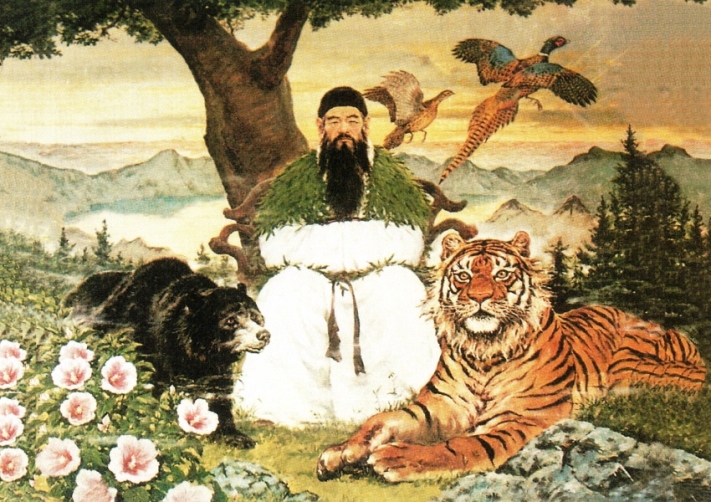
Dangun Mythology
              However, times have changed. The human civilization has taken another step from the limited unit of nations and countries. Although the world is still organized in these units and we are heavily influenced by the policies of individual governments, people are now capable of easily moving to another country and are given mobility rights. There are those who try to challenge this modern trend of globalization and claim that it will only increase the gap between the rich and the poor. However, what’s clear is that restricted regions cannot fulfill human needs to its fullest and so the range of human activity continues to widen. This phenomenon is what fuels the globalization boom and is something we cannot deny.


             Under such circumstances, past ideologies of romantic nationalism to more extreme forms of nationalism, such as Nazism, are being reconsidered. They are being thought of as unreasonable, impractical, and moreover discriminative especially toward foreigners. It’s viewed as a barrier in achieving globalization. To add on, organized efforts to maintain peace and international interest in curing diseases show that the need for unification by nationalism is no longer necessary as now we serve a bigger purpose, the preservation of peace and mankind. Therefore, nationalism now remains as a remnant of the past.

            However, the Republic of Korea has recently been walking along the footsteps of mankind backwards. The government’s policies seem to support globalization, but at the same time they try to revive the ideology of “minjok,”which roots in the archaic ideas of romantic nationalism. It’s because of these policies that the overall understanding of citizenship within the country is based on the sharing of a common bloodline and ancestry. Such a concept of nationhood based on race is the main factor in discouraging foreigners from seeking a life in Korea and in preventing Korea from becoming an international hub. Yet, the government still carries out such “minjok” policies alongside with its plans for globalization. In order to understand this paradox, it’s essential to look into the history of the ideology and take a new perspective into what it means to be a Korean.

History of “Minjok”
             Unlike the general consensus within Korea, the “minjok” ideology is rather young. It was created during the early 20th century, during the period of Japanese colonialism. In order to assimilate Korea into the Greater East Asia Co-Prosperity Sphere as an obedient colony, the Japanese tried to input the belief that Korean and Japanese citizens share the same origin, but also that the Japanese are superior. Such belief would have had simplified the following process of eliminating Korean cultural traditions and replacing them with Japanese ones. This step included the mandatory usage of Japanese names as well as the language, instruction of the Japanese ethical system at schools, and the worship of Shinto. Although the policies had certain levels of effect, the Koreans resisted strongly toward the compulsory elimination of their cultural identity and the outcome of their resistance was “minjok.” “Minjok” was first mentioned by Shin Chaeho, the founder of the nationalistic historiography of Korea and a Korean independence activist, in his “New Reading of History” of 1908. It defined the “minjok” as a warlike race that had fought courageously to preserve Korean identity, had later declined, and now needed to be revived. Due to the situation at the time, this concept that gave uniqueness to the Korean cultural identity gained great fame and spread spontaneously.

The “minjok” ideology grew even stronger and began taking place as an old Korean heritage when more support came from historians like Shin Chaeho and even the Japanese. As it became clear that the primary approach to the Koreans failed, the Japanese changed their policy to creating a patriotism restricted to the Korean ethnicity. They encouraged the Koreans to take pride in their ethnicity and this significantly empowered the “minjok” ideology. Another important trigger to the vast outspread of this metanarrative is Shin Chaeho. His publication of the “Joseon Sanggosa” during the years of 1924 and 1925 created a whole new perspective of the history of Korea. He first proclaimed that Koreans are the descendants of Dangun, who was introduced before in the Buddhist monk Iryeon’s “Samguk Yusa” in the 13th century but remained as a legendary figure. Shin Chaeho also identified the martial roots of the Koreans in Goguryeo, a military and expansionist country, which encouraged resistance against the Japanese. Other new understandings of Korean history are the replacing of Gija Joseon, which was believed to be founded by a Chinese royalty, with Dangun Joseon to strengthen the uniqueness of “minjok.”

             This Korean concept of minjok is similar to Facism of Italy, Nazism of Germany, and nationalism of Japan in that they all are extreme forms of romantic nationalism. Although many Koreans try to deny this fact and the world has yet acknowledged “minjok” as ultranationalism, there is a clear similarity in that the four all proclaim ethnic homogeneity and the preservation of pure blood. However, there are also definite differences. Unlike Italy, Germany, and Japan such ultranationalism did not lead to a full-on war against the world and therefore it has not received any forms of restrictions by the rest of the world. This lack of limitation is the reason why “minjok” continued to exist as a form of “cultural heritage” within Korea even after the end of the Japanese colonialism.

             However, there was also something else that added fuel to the fire and continued the “minjok” legacy. It was the Korean government. Especially when it comes to the dictators and military regimes that formerly took power in Korea, the government made use of the “minjok” ideology to unite the people and serve for the nation. A typical example of such government usage of nationalism is the military regime of President Park Chung-hee in the 1960s. In order to legitimize his authoritarian rule, he strengthened the ideology of pure blood. However, not only did it empower President Park’s regime, but it also created a sense of sacrifice among the citizens for the "Great Han" race, which consequently led to extreme rates of development.

Problems Associated with Minjok

             Returning back to current times, there exists a widespread criticism of nationalism in the globalized society and yet “minjok” still roots deeply into the Korean society. Then exactly why is it that nationalism like the “minjok” ideology receives criticism?

             To begin with, a fatal flaw within the ideology of “minjok” itself is that it is all a fraud. Even its creation is known differently from reality. As mentioned above, the general idea of “minjok” within Korea is that it is a cultural heritage handed down from our ancestors from the very beginning of human civilization. Instead, it was actually created in just the last century. The reason why even the creation of the ideology is misunderstood is that the creators of “minjok” carefully engineered it in such a way. The separate words min, which means people, and jok, which stands for family, had been used very often for a long time, ever since the classical era. Therefore, the combination of these two words, which the Koreans were very familiar with, obscured the truth behind the creation of “minjok” and added an aura of naturalness as well as a sense of cultural importance to the ideology. Moreover, at the core of the “minjok” ideology stands legends, myths, and partial interpretations of history that are hard to refer to as actual evidence.

             Another problem created by the “minjok” ideology is the wrong emphasis on Korean culture. Due to the obsession of ethnic homogeneity created by “minjok,” one can often observe misinterpretations of universal phenomena and values as being Korean when sharing a discussion with a Korea person. A common example would be a Korean talking about how Confucianism had affected Korean culture in the past and so that they “respect the elders.” Confucianism did have a big impact on Korean culture in ways such as forming their own unique way of greeting elders, but the virtue of respecting elders itself is a universal value that can be found in any country. Another example that not many know of is about the Aesope Fable, “The Honest Woodman.” It is a tale that teaches the moral that “honesty is the best policy.” In Korea, many hear of this story ever since childhood and remember it throughout their entire life. The difference between the original Aesop Fable and the Korean version is that in the Aesop Fable appears the god Hermes, but in the Korean version appears a san-shin-ryung, which is a spiritual figure that guards the mountains. Because this figure has existed in Korean culture ever since the introduction of Taoism to Korea, many Koreans mistake that this tale as being “made-in-Korea” and are never told of the origin when they learn about it as a child. Therefore, even adults live on thinking that the tale of “The Honest Woodman” is “pure Korean.” Much of the responsibility for such misinterpretation can be said to lie with the Korean government. However, when it should be educating clearly what Korean heritage is, it instead carries out policies relating to the strengthening of “minjok.”


             Above all else, the biggest problem with “minjok” currently is the discrimination against foreigners. As “minjok” is a form of nationalism that emphasizes a pure bloodline, it blocks out the possibility of a foreigner or even “mixed-bloods” like Korean Americans from being Korean. This phenomenon in the Korean society is somewhat like xenophobia in that the Koreans are afraid to embrace foreigners into their society as people with Korean nationality. In the case of mixed-race people and migrant workers in Korea, the majority of them face various forms of discrimination and prejudice. Famous mixed-blood stars such as football player Hines Ward and singer Yoon Mi-rae are doing their part in the society as they show effort to decrease the discrimination by creating charity foundations or guaranteeing education to the children. This pure blood theory eventually became an international issue in 2007 when the U.N. Committee on the International Convention Elimination of All Forms of Racial Discrimination began paying attention to it. However, what’s more interesting is the response of the Koreans. There were certain levels of positive intakes of the international issue, but what’s shocking is that certain Koreans raised concerns about foreigners invading the Korean culture and challenging their national sovereignty. In the era of globalization and democracy, there is in no way that Korea can keep up to the development in international relations and become a multi-cultural hub if it continues to maintain the “minjok” ideology. 


The Future of Korea and what it means to be Korean

“Minjok” is a form of nationalism that ties the people to the land and pursues the preservation of pure blood. Then, there is patriotism. Patriotism’s original definition is the cultural attachment to one’s homeland. More specifically, it is the love and loyalty one is willing to give to their homeland. However, modern definitions of patriotism show a more broadened perspective on love toward a nation. It now refers to the strong love one feels toward the country they are attached to, which may and may not be the country one was born in. It is such patriotism that should define a person’s nationality, not his or her blood or skin color. If a foreigner shows passion and great attachment to the country of Korea then he or she should be called a Korean just like any native Korean. In order for Korea to truly seek globalization and become a multi-cultural hub, it needs to open up to foreigners and mixed-blood people. The criteria of nationality should no longer be blood but the attachment one has to the country and the willingness he or she possesses to carry out duties for the privileges the country will give to the individual.


             What the country needs for a change in the overall atmosphere of the society is a trickle-down effect and the perfect starting point for it is a change in the policies of the government. It primitively needs to end further support for the idea of “minjok.” However, the Korean government also has a responsibility to change the course of its globalization policies as well. The current globalization policies focus on the spread of Korean culture and the creation of an international interest in the details of the country of Korea. This is the reason why in many of globalization promotion pictures put in public by the Korean government are of foreigners eating kimchi. Rather than trying to maintain a Korea-centered analysis of the world, Korea itself needs to open up to the diverse cultures of the universe without discriminating them. The new focus of globalization should be to accept diverse cultures and people with open arms as well as seeking to spread Korean culture.

2013년 6월 6일 목요일

Euro Debt: Should the euro zone's debt be mutualized?


Paul De Grauwe and Ansgar Belke both agree that debt mutualization would bring along certain dangers, such as morality issues and the burden put on creditor countries through the increase in costs. They also agree that it’s important for European countries to pull weak banks and sovereigns from a vicious cycle. However, they differ in terms of solving the problem itself. Mr. De Grawe believes the problems brought along with debt mutualization could be avoided through careful measures, such as imposing conditions on the beneficiaries of debt mutualization. In addition, he believes joint-issued debt would solve the problem of weak sovereigns with the richer countries guaranteeing the debt of the weaker ones to a certain extent. He defines the main threat to the Eurozone as being mere fear and panic that can lead to a sudden increase in borrowing costs. On the opposing side, Mr. Belke believes that the flaws of mutualization are unavoidable and so the European Union should not resort to such methods. Instead, the E.U. should start with saving banks through stronger central management and shared-liabilities among certain banking sectors. His definition of the main threat also differs from Mr. De Grauwe. He claims it is the untimely removal of market pressure and talks about how debt mutualization will only add on a political backlash, related to the disproportionate liabilities put on creditor states.

Arts Funding: Should governments fund the arts?


With the government incapable of sufficiently funding the basics such as education and health, there has been a major decrease in public, as well as private, funding for the arts. While those in the art industry have been expressing their grief in many extreme ways, the general opinion is that the government does not have a responsibility over funding of the arts. Most simply assume that it would be better to use tax on street lights and hospitals rather than art shows and galleries. However, Alan Davey, who is the current chief executive of the Arts Council in Britain, takes on the opinion of its founder, John Maynard Keynes. Keynes’ belief that public funding in arts would bring economic and cultural benefits is what brought the council about. Such movements to bring about public spending are what enabled Britain to be a hub of top quality museums and theatres with affordable prices. Public support also brought about more private funding as well. In the end, it all boils down to increase in cultural export, quality of neighborhoods, number of jobs and tourists, and an abstract sense of pride in each citizen. However, Peter Spence of the Adam Smith Institute argues that government interference in arts rather does more harm than good. With the government involved, the censorship brought along would put a limit to the creativity of artists. It gives the government the power to choose which type of artists to root for, leading to a situation where artists are merely trying to satisfy government donors and their political beliefs. There is much debate about this topic and the question still remains, could we leave the future of arts up to the market during a time of economic difficulty?

Offshoring & Outsourcing: Do multinational corporations have a duty to maintain a strong presence in their home countries?


An outsourcing trend had spread among the multinational corporations with not only basic manufacturing work, but also crucial functions such as R&D being moved to fast-growing markets. However, the Great Recession’s impact has caused many to hold grudges against such trends. Therefore politicians are pressuring firms to keep operations within the borders or bring them back home. With so much objection expressed toward corporations going overseas, they have started a kind of trend called “reshoring,” in fear of further public dispute. Now, even chief executives are emphasizing the importance of staying, rather than expanding. They proclaim that firms have a duty to their home country and that it’s also in the best interest of the corporations as well. Among such supporters is Harry Mosers, who is the president of GF AgieCharmilles and claims that the firms have a responsibility to pay back to the state that have granted them privileges right from the beginning. He also states that merely going offshore due to the bandwagon appeal and with no correct measuring rather damages the firms. On the other hand, professor of economics and law at Columbia University, Jagdish Bhagwati, says we should tilt our head toward reality, in which multinationals do make profit from foreign investment.

Affirmative Action: Is affirmative action a good idea?


Many different governments have carried out policies of affirmative action to compensate for past discrimination of racial minorities. Supporters declare that it shatters the glass ceiling, allowing certain ethnic group to enter higher economic and social status. Adding on, affirmative action creates a classroom of diverse ethnicities and makes up for the pure luck involved in birth by providing more opportunities to those who aren’t so lucky. On the other hand, opposing views point out how such policies only benefit the powerful and wealthy households of such ethnicities that have been historically discriminated. Further on, affirmative action cannot be justified as it’s merely an extension of discrimination by ethnicity and race. Professor Ashwini Deshpande further supports Affirmative Action by talking about how it will have a trickle-down effect with social minorities in decision making positions and how it will level the playing field. She also rebuts to a few points, such as the criticism that AA only further stigmatizes these minorities. She points out that AA counters the current stigma that exists independently and that critics should shift their focus to successful cases like the castes of India. She claims that the criticism about AA being regressive is merely a myth. On the opposing side, professor Lino A. Graglia states that AA is inconsistent with an important value that humanity upholds, equality. He claims the actual problem is that certain ethnic groups lack in certain abilities and that the society is merely trying to cover this fact up.